AI Flashcards for Med & Nursing Students
86% of med students use Anki — but spend hours making cards. Arc's AI flashcard generator creates them from any screen. Free to try.
If you are a medical or nursing student, you already know the numbers: 86% of U.S. medical students use Anki. It was the 4th most downloaded paid app on Apple’s App Store in 2025. The spaced-repetition algorithm works — there is a reason nearly everyone in med school swears by it.
But here is what nobody talks about: the hours you lose making the cards. On Arc, students generate over 500 flashcard sets every month from their screens — and that’s just the ones who’ve found the feature. The demand is clear: people want the retention without the manual labor.
Anki’s algorithm is brilliant. The card-creation process is not. You read a textbook chapter on pharmacology, identify 40 facts worth memorizing, manually type each one as a question and answer, add tags, maybe find and paste an image. Do that for every lecture, every week, across multiple subjects — and you are spending more time building decks than actually studying them.
One med student on Reddit put it plainly: “I was considering paying for Anki. I’m a first-year med student.” The reply: “It’s worth it for the convenience.” Worth it — but still a grind. What if the grind was optional?
The Hidden Cost of Manual Flashcard Creation
The research is clear: active recall — testing yourself on material — is what drives retention. The act of creating flashcards is not the active part. It is overhead. Yet for most students, the overhead consumes the majority of their study time.
Here is what the manual workflow looks like:
- Read a textbook chapter (30 minutes)
- Identify key facts (10 minutes of highlighting and mental triage)
- Type 25-40 cards in Anki (20-30 minutes)
- Actually review the cards (15-20 minutes)
More than half your session is gone before you flip a single card. And that is assuming you have the discipline to sit down and make them. Many students simply skip flashcards when they are tired or behind — even though they know spaced repetition is the single most effective study technique available.
For nursing students preparing for the NCLEX, the problem is the same but the stakes are higher. You are juggling pharmacology, anatomy, patient care protocols, and lab values. You do not have 30 minutes to spend on card creation — not when your licensure exam is in six weeks.
Arc’s AI Flashcards: Point at Your Screen, Get a Deck
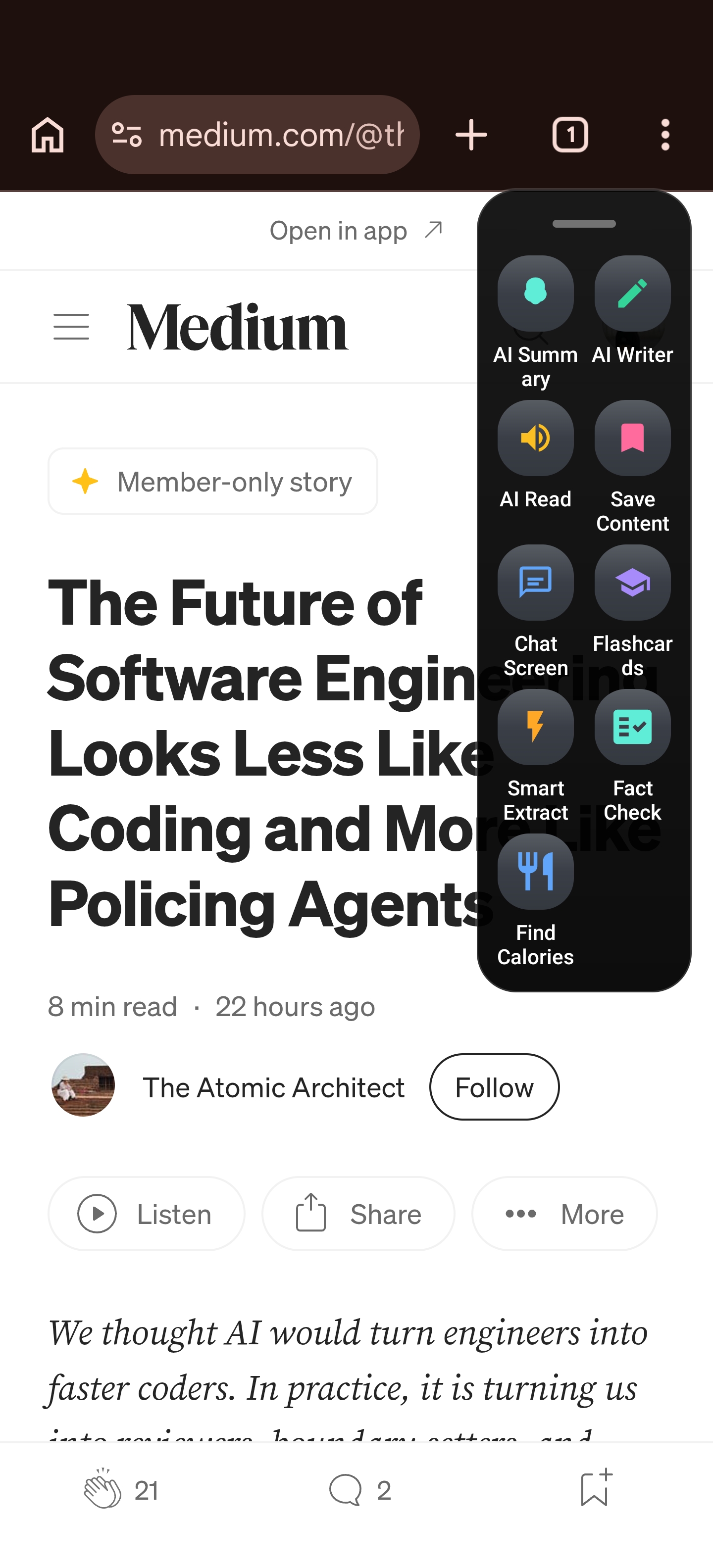
Arc takes a fundamentally different approach. Instead of requiring you to manually create flashcards, it reads whatever is on your phone screen and generates a complete deck instantly. Students generate over 500 flashcard sets every month on Arc — and those decks are viewed nearly 2,000 times, because the cards you don’t have to make are the ones you actually review.
Here is how it works:
- Open your study material — a textbook PDF, a First Aid page, lecture slides in Google Docs, a UWorld explanation, a Picmonic video frame — anything on your phone.
- Expand the Arc sidebar — swipe in from the edge. Arc floats over your current app.
- Tap Flashcards — Arc captures the text on your screen, sends it to AI, and generates a full set of structured flashcards in about five seconds.
- Study immediately — each card has a question, a hint, and a concise answer. Flip to check yourself.
- Save or regenerate — save the set to your Flashcard Library, or hit Regenerate for a fresh set from the same content.
No typing. No app switching. No deciding which facts matter — the AI handles that. You go from “I am reading this chapter” to “I have a 15-card study deck” faster than you could create a single card in Anki.
What Med and Nursing Students Actually Study with Arc
Anatomy and Physiology
Open a diagram or textbook page covering the branches of the facial nerve. Tap Flashcards. You get cards testing you on each branch, its pathway, and its function — generated from the exact content you were reading. The specificity matters: your cards match your curriculum, not a generic anatomy deck.
Pharmacology
Reading a drug monograph for metoprolol? Arc generates cards covering mechanism of action, indications, contraindications, and key side effects. Do this for each drug in your syllabus and you build a personalized pharmacology deck without typing a single card.
Pathology
Dense pathology slides are where manual card creation is most painful — the material is complex, the facts are numerous, and the time pressure is real. Arc turns a Goljan audio transcript, a pathology textbook page, or your own lecture notes into review cards in seconds.
NCLEX Prep for Nursing Students
Studying lab values, ABG interpretation, or priority-setting frameworks (ABC, Maslow, nursing process)? Arc generates cards from any review material on your screen — UWorld rationales, your NCLEX review book, or even a summary you saved from a study group chat.
Beyond Flashcards: Arc’s Full Study Toolkit
Flashcards are where most students start, but Arc gives you more than a single-tool app:
Math Solver 📷
Point your camera or screenshot at any math problem — dosage calculations, IV drip rates, biostatistics equations — and get step-by-step solutions. For nursing students calculating medication dosages, this alone replaces a separate calculator app.
Generate Quiz Questions
Run this on your lecture notes or textbook chapter and get five quiz questions (mix of multiple-choice and short answer) with a full answer key. Self-testing before an exam without spending 20 minutes writing your own practice test.
ELI5 (Explain Like I’m 5)
Stuck on a mechanism you cannot wrap your head around? ELI5 strips away the jargon and explains it in plain language. Perfect for immunology pathways, acid-base physiology, or any concept that feels impenetrable.
Analogy Generator
Maps abstract concepts to real-world comparisons. “The renin-angiotensin-aldosterone system is like a home thermostat, but for blood pressure.” Analogies are one of the most effective ways to lock in understanding — and Arc generates them on demand.
AI Summary
Summarize any article, chapter, or document on your screen into key points. Before a lecture, use it to preview the reading. After, use it to review what was covered. Save summaries to your library and revisit them before exams.
Fact Check 📷🌐
Verify claims in your study material with sources. When a textbook explanation feels off — or when ChatGPT gave you an answer you are not sure about — Fact Check provides a verdict with reasoning and source links.
The One-App Reality: Why Paying for Five Study Apps Is Over
Here is what the typical med student’s app stack looks like:
| App | Purpose | Cost |
|---|---|---|
| Anki | Flashcards | $24.99 (iOS) or free (Android) |
| Quizlet Plus | Flashcards + practice tests | $35.99/yr |
| Photomath Plus | Math solver | $9.99/mo ($59.99/yr) |
| ChatGPT Plus | AI explanations | $20/mo |
| UWorld | Exam prep | $399+ |
That is $50-100+ per month across multiple apps, each doing one thing. And students report frustration at the fragmentation — switching between apps, copy-pasting content, managing separate login credentials and billing cycles.
Arc replaces the first four on that list. Not with stripped-down versions — with features that work the same way: you point at your screen, and Arc acts on what it sees. One app. One sidebar. One learning curve.
UWorld remains essential for exam-specific practice questions — nothing replaces question banks. But for everything else — flashcards, math, quizzes, explanations, summaries — Arc handles it from a single floating sidebar.
Real Workflow: A Med Student’s Afternoon
2:00 PM — Reading First Aid for the USMLE Step 1 on your phone. Open Arc, tap Flashcards, get a 20-card deck on the renal physiology section. Study the deck.
2:30 PM — Confused about the countercurrent multiplier. Tap ELI5 on the same page. Get a plain-language explanation. Tap Analogy Generator. Now it clicks.
2:45 PM — Quick self-test. Tap Generate Quiz Questions on the same material. Get 5 questions with answer key. Score 4/5 — the one you missed is about juxtaglomerular cells.
3:00 PM — Move to pharmacology. Open a drug table. Tap Flashcards. New deck, zero typing. Save it and move on.
3:30 PM — Dosage calculation practice. Screenshot a practice problem, tap Math Solver. Step-by-step solution. No separate calculator app needed.
You just covered renal physiology and pharmacology in 90 minutes — with active recall, comprehension, self-testing, and calculation practice — without leaving your study material or manually creating a single card.
For Nursing Students: Your NCLEX Study Companion
The NCLEX demands breadth across pharmacology, medical-surgical nursing, maternal-child health, psychiatric nursing, and more. Arc’s screen-first approach means you can:
- Generate flashcards from UWorld rationales — the explanations you read after each practice question are some of the highest-yield study material you have. Arc turns them into cards instantly.
- Quiz yourself from review books — tap Generate Quiz Questions on any NCLEX review page and get practice questions tailored to your current material.
- Solve dosage calculations — Math Solver handles the math while you focus on clinical reasoning.
- Explain complex protocols — ELI5 and Analogy Generator break down priority-setting frameworks and disease processes into language that sticks.
The Bottom Line
Anki’s spaced-repetition algorithm changed how medical and nursing students study. But the manual card-creation step is a relic — a time tax on students who already study 60-80 hours per week.
Arc removes that tax. Point at your screen, get a deck. No typing. No switching apps. No lost study time to overhead.
If you are spending more time making flashcards than reviewing them, it is time to stop grinding and start studying.
Try Arc free on Android — download from the Google Play Store and generate your first flashcard deck in under a minute.